
TEACHING CONTENTS:
Teaching Philosophy
Course Rationale
Course Progression
Student Assessment
Sample Paper
Sample Grammar Revision
From My ENG 102 Site:
Course Policies
Daily Assignments
All Major Assignment
Current Catalog Description: ENG 102: English Composition II
ENG 102 focuses on writing the college-level research paper and develops each student’s mastery of communication, information literacy, and analytic skills with emphasis placed on research and documentation methods. Students use writing, reading, listening, and observations skills to understand, organize, receive, and convey information. Using research gleaned from diverse sources, students employ logic, reasoning, and analysis to craft effective essays.
Course Rationale
The current design of my English 102 course reflects four major priorities in my approach to fulfilling the mandated learning outcomes. First, students need to advance their writing skills beyond those developed in English 101. Second, to improve their writing skills, students need to learn how to find, document, and synthesize college-appropriate sources to support meaningful written arguments. Third, to support their ability to synthesize sources, they need experience reading, decoding, and quoting difficult texts to support their arguments. Finally, to develop the kind of college-level analytical skills future courses will require, students need a course theme that allows them to build a sustained knowledge base for use in written arguments.
Towards that end, I have developed a semester-long study of monsters in literature and culture as a means of challenging my students to write about difficult social issues. The topic amounts to a "bait and switch" move on my part: on the surface, there's something inherently silly about writing about vampires, alien predators, zombies, and the whole gamut of cinematic and literary monsters. As the semester progresses, however, they learn that monsters embody the social taboos that define the fears and anxieties of a specific cultural moment. Analyzing their effects on audiences offers students a safe space to talk about issues that are relevant to their own lives without the initial reluctance inspired by straightforward courses on multiculturalism, sexuality, gender, addictions, violence, religion, science, and the like. My students "discover" these issues as the semester unfolds, prompting them to seek more complex interpretations of the monsters by tackling relevant social problems.
The First Unit: The Strange Case of Dr. Jekyll and Mr. Hyde
The first reading assignment, Robert Louis Stevenson's The Strange Case of Dr. Jekyll and Mr. Hyde, immediately sets a tone for my expectations of students. I start with this text because as a genuine classic of both Victorian and monster literature, the novel signals that the course will not focus on the short essays typical of English 101, that they are expected to handle texts outside their linguistic comfort zone, and that the image of the monster has long been an accepted literary topic. Given that the text is much shorter and easier to digest linguistically than other classic monster novels like Frankenstein or Dracula, the assignment feels challenging without actually overwhelming the majority of students.
The real challenge comes when I require students to read and mark the first half of the novel by the second class meeting, with the rest of the text to be read and marked by the third class. To assist them with the unfamiliar task of annotating a reading, I have students download from Blackboard a two-page essay on marking a book that I wrote for a textbook. The students attempt to apply the directions from the essay, and I hand inspect each student's copy of the novel and verbally comment on the quality of their marks, noting effective strategies he or she employed and suggesting ways to improve their annotations. Afterwards, we talk as a class about what kinds of content was worth marking (plot points, characters, symbols, vocabulary, repeated patterns, etc.) and various methods of marking (highlighting, Post-it notes, annotations, character lists, page references, etc.). The discussion lets students with a high degree of comfort marking a text teach the students with little or no experience what to look for and different ways to handle the marking process. We discuss how their marks will help them to find evidence for class discussions and their first major papers. We also consider how to apply this skill in other courses, noting how the physical memory of marking aids information recall and how a marked text is easier to review come exam time than re-reading the entire book. Finally, by the end of the third class, I point out that each of them has successfully read, marked, discussed, and digested a major classic of English literature in less than a week, a significant accomplishment for many.
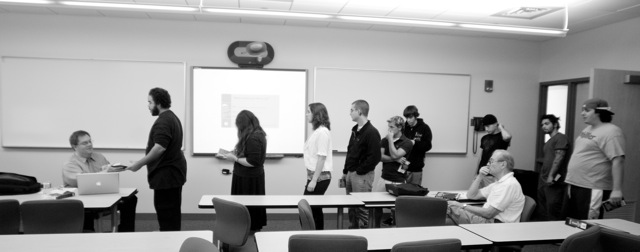
(Dr. Halbert conducting a reading check. Photo by Greg Hardin)
Because my students have actually read the novel, we can then turn to class discussion, a vital method for generating ideas for the upcoming paper. During our first discussion, I explicitly demonstrate how students should use textual evidence as the basis for individual interpretations by leading them through a specific passage from Dr. Jekyll and Mr. Hyde:
I was coming home from some place at the end of the world, about three o'clock of a black winter morning, and my way lay through a part of town where there was literally nothing to be seen but lamps. Street after street and all the folks asleep—street after street, all lighted up as if for a procession and all as empty as a church—till at last I got into that state of mind when a man listens and listens and begins to long for the sight of a policeman. All at once, I saw two figures: one a little man who was stumping along eastward at a good walk, and the other a girl of maybe eight or ten who was running as hard as she was able down a cross street. Well, sir, the two ran into one another naturally enough at the corner; and then came the horrible part of the thing; for the man trampled calmly over the child's body and left her screaming on the ground. It sounds nothing to hear, but it was hellish to see. It wasn't like a man; it was like some damned Juggernaut. I gave a few halloa, took to my heels, collared my gentleman, and brought him back to where there was already quite a group about the screaming child. He was perfectly cool and made no resistance, but gave me one look, so ugly that it brought out the sweat on me like running. (Stevenson 39-40)
This harrowing scene depicts the first encounter with Mr. Hyde, and it invites a number of interpretations. I start by asking students to consider the setting established in the opening lines, and they quickly debate if the setting is meant to be peaceful (after all, it's a quiet night) or ominous (the fog, the absence of people, "the end of the world" on a "black winter" night). Inevitably, one student will ask about desire to see a police officer, and students will then recall moments when they, too, have wished a cop were around on a deserted street. If nobody else makes the observation, I point out that by having the narrator invoke the feeling, Stevenson is manipulating readers to substitute their own memories of fearful moments to heighten the anxiety, a guided comment that makes them aware that they should start looking for deliberate audience manipulations. Having established the scene, we then demonstrate the action of the accidental stomping of the child so that everyone understands what actually happened, and then we discuss Hyde's complete disregard for the child's injury in terms of what a normal person would do if he or she had inadvertently hurt a child. Some students argue that he should have shown compassion and concern for the child ("Are you okay, sweetie?"), while others argue that even if he didn't care about the child, he needed to make a show of compassion in order to avoid conflict with the witnesses who expect it. When I ask them what to make of his "calmly" trampling the child, the debate turns to if he is unaware of or completely indifferent to the harm he has caused. This discussion lays the groundwork for subsequent questions about social norms, personal freedom, and emotional development. Generally, the majority of the class participates in this dialogue, and their disagreements force them to return to the text to support their claims. By seeing others interpret the text and proposing their own theories, they start to think more analytically about what they have read—and about how they will support the claims they will make in subsequent discussions and their first papers.
After two days of discussions, we turn to the paper assignment, going over the entire writing prompt as a class and asking questions about the requirements. Students often don't know how to read the clues about instructor expectations, and asking or hearing questions about the assignment helps them to formulate their approach to the task. Note that the writing prompt lists three very directive topics and an additional open topic that invites students to essentially offer their own interpretation of a theme or feature of the novel. For students who like limits, the focused topics provide a specific framework for their first paper. Advanced students like the freedom the open topic provides, sometimes drawing from the suggestion that "Potential areas of discussion include addiction, psychology, science, social class, and more." Often students draw from their personal experiences with addiction in the family, while others turn to content from other courses, like Psychology, Sociology, or one of the sciences to enhance their interpretation. The listed expectations provide very specific criteria for success, particularly the 3-4.5-page length requirement that is far longer than the two-page, five-paragraph essay required in most English 101 courses. The overt list of skills being developed helps students to see the larger composition goals of the task. Essentially, they are writing a traditional literary analysis with strong textual evidence to support a specific interpretation rather than simply summarizing.
After reading about and hearing a presentation on the basics of documenting a single source using the MLA Style Guide, students write their first drafts and bring them in for peer review. To get credit, students need to bring a hardcopy to class and post the draft to the discussion board as both copy and paste text and an attached file. The discussion board post allows students to see how others approached the same task, providing a model for weak writers to mimic without plagiarizing while advanced writers can see alternative styles in action, broadening their potential approaches to the current or future papers. The attached file also serves as backup storage should a catastrophe strike the student's personal copy of the file. For the peer review, students are provided a handout on how to provide constructive criticism and a series of questions they need to answer in the form of a note to their partners. The goal is to mark the draft thoroughly not just for errors or confusing sections, but for successes as well. The note provides a real reader's reaction that the writer can use as a guide for the next draft. Strong writers benefit from learning how to articulate their concerns in ways their partners can understand, while weaker writers can see what a successful paper looks like while receiving suggestions for revision.
After the first draft is revised, each student schedules a 15-minute, one-on-one conference with me to discuss the revision and to map out the final draft. These conferences occur in my office, and they require that I find a minimum of 15 extra hours in the week in order to meet with all 60 students. Each conference starts with me asking if the writer has any concerns about the current draft. I then read the paper in front of the student, pen in hand to employ a minimal marking method of signaling error on a line without specifically labeling or fixing it. This method helps students to learn to spot their own errors, making them better editors of their own work. I write comments in the margins when a section seems redundant, confusing, or contradictory, and I record positive reactions to arguments, turns of phrase, and particularly strong analyses of textual evidence. Once the essay is read, we discuss the strengths and weaknesses in a reassuring—but realistic—way, and the student then has a final opportunity to revise the paper before submitting it via email and to Turnitin.com for a grade.
When students turn in the final paper, they write notes to me assessing themselves using four questions:
- What are you most proud of with the paper (besides completing it)?
- What was the single biggest challenge you faced in developing your argument and completing your paper?
- What would you change about the final product if you had 24 more hours to revise?
- How will your experience writing this paper affect your approach to how you read for and then draft your next paper?
These notes allow students to step back from the frantic pace of the reading and writing cycle to evaluate what did and did not work in their approach to a reading and writing task. They are often very accurate in assessing what worked with the final paper and what needed to be revised, and they are brutally honest about their work ethic and their mistakes. It reminds them of the larger goal of the course, which is to improve their writing skills, and it helps them to formulate specific ways to reach that goal.
Finally, when the papers are returned, they receive a thoroughly annotated text outlining errors (using minimal marking), my reactions to claims and textual evidence, and an ongoing commentary on organization, style, and overall effectiveness. I also type a one-page, single-spaced note divided into two parts: a discussion of what worked well in the paper and a list of areas that could be improved with revision. Students can use this note and my comments as a guide should they choose to revise the paper for a completely new grade under the terms of the major paper rewrite option I give all my students. This option transforms the note from an autopsy to a revision guide, allowing students to not only learn about their weaknesses, but also to actually address them through a rewrite. Because my expectations for a revised draft are so high, such rewrites almost universally show significant improvement. Most students who take advantage of this opportunity indicate verbally that they are surprised at how much they were able to do to improve the paper, and the satisfaction they take in the final product derives in equal parts from extrinsic value of the grade and intrinsic satisfaction of a job well done.
By the end of this unit, students will have faced high expectations for their reading, discussion, drafting, editing, and revising skills. They will have reviewed the basics of source documentation and integrating quotations into an argument, and they will have learned to develop their arguments beyond the scope of a basic five-paragraph essay.
The Second Unit: Monster Theory, I Am Legend, and 28 Days Later
The second unit expands upon all of the skills from the first unit by giving students more options in terms of their paper topics, adding a scholarly critique to their argument, challenging them to read above their current comfort level, and integrating multiple sources into a single paper. During the first week of the unit, the students read and mark Richard Matheson's I Am Legend (1954) while we watch Danny Boyle's zombie masterpiece 28 Days Later (2002) in class. Once both the novel and the film are discussed, they read three critical pieces on monsters and horror: Jeffrey Jerome Cohen's "Monster Culture (Seven Theses)," a chapter from David J. Skall's The Monster Show entitled "It's Alive, I'm Afraid," and a chapter from Peter Hutchins' The Horror Film entitled "Slashers and Post-slashers." The goal is to have students offer an interpretation of either the novel or the film that employs the ideas or methodology of one of the critical essays as part of its argument.
The texts and films of this unit work well together. I Am Legend, the classic tale of a solitary human survivor of a vampire infestation of the Earth, is a short novel written in straightforward language, but the thematic elements offer rich layers of meaning for interpretation: loneliness, alcoholism, faith in science, shifting social norms, gender relations, myth making, ethical behavior in the face of calamity, and more. 28 Days Later, a modern take on the zombie film, presents a modern United Kingdom overrun by people infected with "rage," a man-made virus that transforms humans into blood-spewing, fast-running zombies. The film touches on issues of isolation, loss, family, violence, gender roles, science, ethical behavior, hope, despair, and what an individual might do to survive. "Monster Culture (Seven Theses)" serves as the plus-one reading of the semester. Written by a literary scholar for other literary scholars, the essay offers six working definitions of what a monster could represent in relationship to social change, the fear and attraction of taboos, and the horror of classification failure in maintaining one's world view. "It's Alive, I'm Afraid" offers a historical explanation of the rise of birth-related horror films in the late 1960s and 1970s (Rosemary's Baby, It's Alive, Alien, etc.) as part of the anxiety caused by the increased availability of birth control and the Sexual Revolution. Finally, "Slashers and Post-slashers" looks at the rise of the slasher film as a response to increased teen sexual activity, focusing on the concept of the "final girl," the virginal female character with somewhat masculine characteristics that survives to either escape or defeat the killer. For students, the two fictional texts are enjoyable and prompt intense discussion, while the theoretical readings expand their potential interpretations into the realm of cultural criticism.
The biggest challenge of the unit for my students is reading, understanding, and using Cohen's "Monster Culture (Seven Theses)" in their essays. The text is very much beyond the majority of the students' reading level, and I caution them to break the essay up into sections and read a piece each night rather than attempting to read it in one sitting. I also urge them to read near a computer with Internet access so they can look up words or concepts they do not know. We then spend two class periods discussing the essay, first in small-groups with a guided question sheet, and then as a class. These discussions require students to work together to try and build meaning out of one small section of the essay so that they can report back to the class. The larger class discussion then brings the entire essay together for students, who offer specific quotes from and interpretations of the essay that other students can use later in their papers.
Additionally, we spend a class discussing the complexities of evaluating sources and how to document sources. Using an activity sheet and the classroom's Smartboard, we review how to cite web pages, works in anthologies, blogs, online encyclopedia entries, and sources from various academic databases. We also look at specific web sites in an effort to discuss what constitutes academically acceptable sources as part of the course's mandate to develop information literacy skills.
Finally, the paper assignment asks students to pick either 28 Days Later, I Am Legend, or Dr. Jekyll and Mr. Hyde and offer a reading of the text using one of the theoretical texts as an interpretive lens. Students can attempt to define who or what should be considered the true monster of the text using Cohen's definitions, and this option produces a wide variety of interpretations: Neville, the surviving human of I Am Legend, has been labeled a monster by students for trying to destroy the new vampire culture of the novel, while the soldiers who lure unsuspecting women to them to be future rape victims in 28 Days Later eclipse the monstrous behavior of the zombies to many students. The historical approach modeled by Skall has led to fascinating discussions of Victorian England's growing awareness of both mental illness and drug addiction as evidenced by Dr. Jekyll and Mr. Hyde, while other students note that today we fear blood-born illness far more than we do witchcraft, making the laboratory virus that produces the zombies of 28 Days Later far more "real" to modern audiences than the voodoo inspired zombies of the 1930s. Students even debate the status of Selena from 28 Days Later as a "final girl," noting her kill-first-and-ask-questions-later persona as the film's machete-wielding heroine changes as she shifts from a nihilistic world view into a more hopeful, feminine character. Some students go so far as to challenge the old definition of a final girl, noting that female characters have evolved significantly since the term was coined in the early 1980s.
By the end of this unit, students will have learned how to use multiple sources within one paper, how to evaluate sources, how to cite different online and print sources, and how to use a scholarly source to support their own arguments. Intellectually, they will have started to see the way academic sources demand readers stretch their own thoughts into more complex interpretations without letting the secondary sources eclipse their own ideas. As a result, students start to write with a somewhat more academic or professional tone, bringing them one step closer to being college writers.
Side Project: The Grammar Revision
After the second essay is submitted, students return to their first essay to perform a grammar revision of the paper. On a separate sheet of paper, students must copy each sentence with a marked error in grammar, punctuation, or citation format. For each error, they must then write out a corrected version of the sentence and then write out the rule that explains why the initial sentence was an error. The goal of the task is to have students focus on the specific errors they make and to review the rules in the grammar book in the context of their own writing. Instead of mindlessly doing grammatical exercises, they must attempt to identify why their own error is not correct and what options they have to fix it. The number of errors students have to fix depends on the quality of their editing: the lowest number of errors I have seen is two, while the largest number for a three-page paper has been 73. Most students discover that they have specific patterns of error, and once they can see that they have specific problems not with "commas" in general, but rather with "commas after an introductory phrase" or "commas plus a coordinating conjunction to join two independent clauses," they start to identify and edit these errors more often.
The Third Unit: The Poetry of Edgar Allan Poe
The third unit is a very short unit designed to help students learn to interpret poems and how to write an in-class essay. Students read several poems by Edgar Allan Poe, as well as a short biographical piece. We then spend a class taking apart "Annabel Lee," Poe's classic poem of love and loss, and at least one other poem selected by the class. The discussion of "Annabel Lee" is presented as a verbal essay to model the thought process they will need to employ when they write an in-class essay on "The Raven": I argue that the poem is not the great love poem most readers initially believe it to be, but rather a symptom of an adolescent obsession that borders on stalking. Having announced my thesis, we read the poem stanza by stanza, taking apart the images as group and then fitting them into my argument. Poe's use of a fairy tale setting, his invocation of their youth, his belief that Annabel Lee thinks of nothing other than loving and being loved by him, his absolute conviction that all the angels and all the demons envy their love, and his remarkably childish claim that their love can never be understood by those "older…/and wiser than we" combine to paint the picture of an adult male stuck in an adolescent obsession with love rather than a true love story. Since the majority of the students resist my interpretation at first, we have a great time arguing the meaning of key words and passages, but the overall point is clear: the tools of the poet—imagery, language, rhyme, voice, repetition, even punctuation—can evoke a range of interpretations. To make a compelling argument, the writer has to identify the source of a particular point in that argument in order to convince the reader that their interpretation is at least plausible.
With that experience as a model of the kind of interpretation they need to offer, the students then read "The Raven" on their own to prepare for their essay examination. We review the basic strategies for a good exam essay: a clear introduction with a thesis and a plan of development, three or more single-issue paragraphs, and a conclusion that ties them together. I then give them two questions about the poem ahead of time, and they get the opportunity to prepare an exam card with an outline and a series of supporting quotes on it that they can use during the exam as a guide to their essay. The real work takes place prior to the actual exam because they are organizing a response on the card. The actual writing of the essay injects the stress of a timed response, but they learn the value of anticipating a question and preparing beforehand, a skill they can apply in future classes even if they are not given the questions beforehand or the option of using an exam card.
The Final Unit: The Research Paper
Having refined their reading, analytical, writing, and citation skills, students end the course with a major research paper. The assignment gives the students three major options: they can write about a monster from fiction, film, or folklore not covered by the course; a supernatural force that does not completely fit into the concept of a "monster"; or a "real" monster drawn from history or recent events. I give the students a lot of latitude as to what constitutes a supernatural force and have gotten some fascinating papers on haunted houses, out-of-body experiences, black magic, and more. In terms of a "real" monster, students often pick historical villains (Hitler, Stalin, Pol Pot, and other genocidal political figures), specific serial killers, or classes of people that commit particularly heinous crimes or offenses against humanity (child molesters, rapists, industrialists, religious extremists, terrorists, bankers, and more). Some of my more adventurous students have gone after non-living calamities like epidemics, weapons of mass destruction, eating disorders, poverty, and war as being "monsters," while others have offered particularly sharp analyses of how certain figures or issues are presented as monsters by political figures or special interest groups in order to use fear to control the population (the fear of terrorism, the swine flu panic, Y2K, socialism, etc.). The challenge is that they have to present an argument to readers, not simply amass information about their topics, and they have to use academically appropriate sources to support their claims.
To get students started, we discuss the paper options in detail and generate a list of potential topics in order to prepare for the library orientation. Our library staff offers presentations on library resources and the research processes that uses references to the assigned topic as the core examples of search techniques. Every semester, I have a librarian come to the class to walk them through the process, and as we go over each resource or step in the process, I reference my own experiences as an active writer in dealing with the challenges of using these resources effectively. In one example, I reference a paper I wrote for the National Popular Culture Association about torture-based horror films like Hostel and Saw. I wanted to generate a list of real instances of non-political torture to show a growing fear of personal attack in everyday life, but I had to use Boolean search terms to remove references to "Gitmo," "Abu Ghraib," "cartel," "South America," and more in order to generate a ten-page list of news accounts of private citizens torturing one another without political motivation. The discussion demonstrates a number of valuable points: that, like them, professional academics often struggle with research; that the details being presented by the library staff have practical value to their current and future academic projects; and that they need to think of alternative search options when they encounter the inevitable hurdle in research. The orientation ends with them receiving a customized research guide created by the library staff, for which I am most appreciative.
Once the orientation is complete, we spend several classes in the library conducting our research in order to prepare annotated bibliographies and for the upcoming two-minute presentations and research papers. Students sign in with me at the library entrance, and they can use either the library staff or myself as resource during the research process. My students then complete two annotated bibliographies and submit them to the discussion board's "Research Bank" thread so that other students working on similar projects can see what other sources are out there on their topics. The annotated bibliographies accomplish several goals: they compel students not just to find but actually read their sources, they force students to create MLA citations ahead of time so they can copy and paste them into the final essay later, they require students to type out possible quotes that can be dropped into the final paper, and they make students offer an evaluation of the source's value to their argument.
Once the research phase is initially completed, students give a two-minute presentation that simply explains what their research project is about and what their specific thesis will be. The task is deceptively simple: students can easily describe the information they find about their subject, but they often get lost in the wealth of information they have accumulated and have a hard time generating a thesis. Since each presentation ends with the opportunity for questions, the students have to think through the issues raised by a live audience prior to actually writing the paper. These questions then become the basis for the writer to conduct additional research, thesis revision, or counterargument development.
Once writing commences, students have multiple peer review sessions and at least one conference with me on their papers. Early peer reviews focus on differentiating between an informational paper and an argument paper, while later reviews focus on fine-tuned editing and mechanics. The final peer review includes a take-home self-review that encourages students to use the FIND command in Microsoft Word (Control-F) to search for common errors with word choice, citation format, and grammar.
As the capstone project of not just the course, but the entire writing sequence at Montco, these papers tend to be the best of the semester because they have learned how to
- Locate appropriate college-level source materials
- Identify solid evidence in those sources
- Document those sources
- Integrate the ideas of others with their own ideas to synthesize a compelling argument
- Present their argument in manner consistent with academic and professional standards.
When my students turn in their final projects, they often express surprise as to how far they have grown intellectually over the course of the semester, and they take great pride in their final papers. They recognize the amount of work I have required of them, but they see that the effect of the workload has helped them to develop into stronger writers and thinkers.
Site created and owned by Dr. Harold William Halbert
Created on March 6, 2011